ADR 008 – Asset Administration Shell Profile for Factory-X Version 0.2.0
Problem to be solved
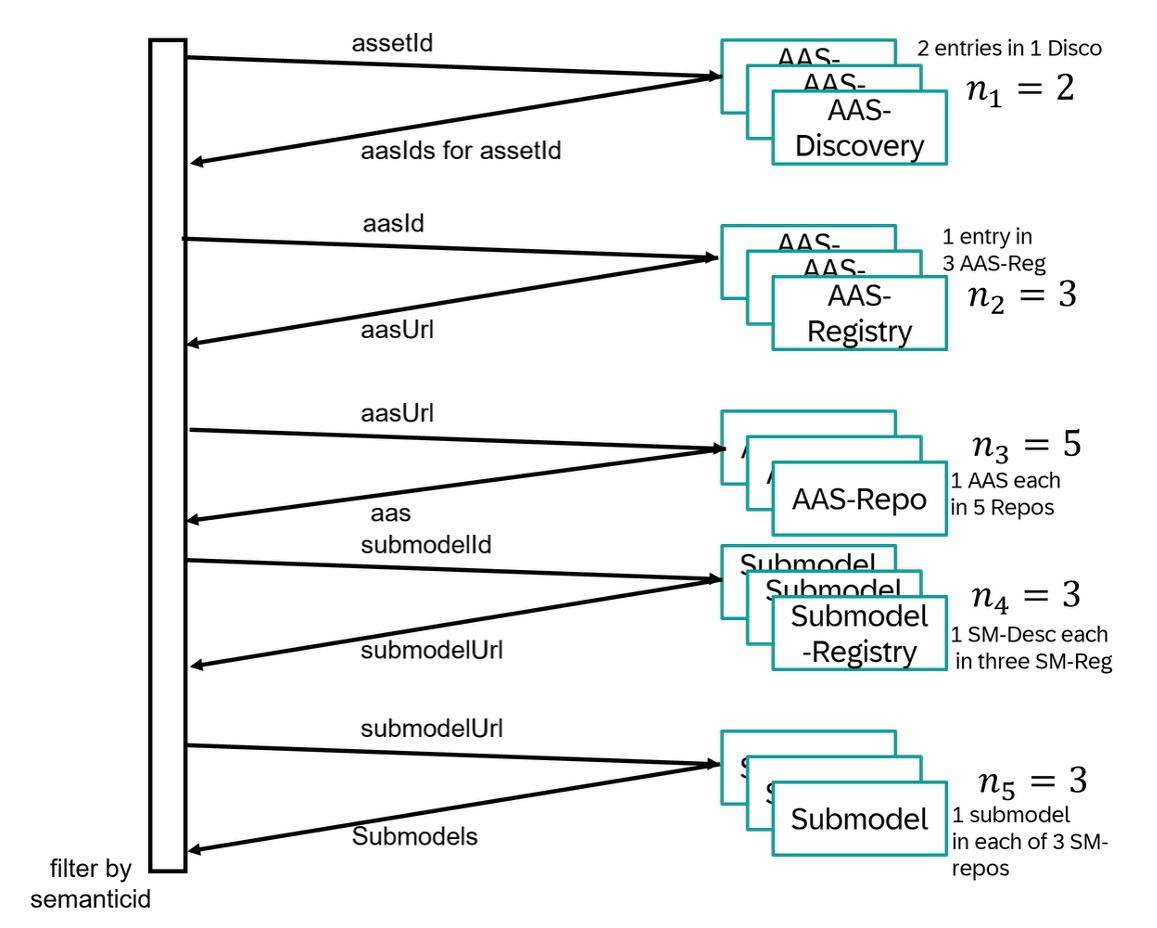
The Asset Administration Shell API-specification (IDTA 01002-3-0-3) defines a discovery and retrieval process for Submodels that makes life hard for Data Providers and Data Consumers. In the worst case, a Data Consumer must have prior knowledge about:
- the
globalAssetIdor at least onespecificAssetIdof the asset she’s looking for. - the
semanticIdof the interested submodel
and URLs of all
- n1 AAS-Discovery Services
- n2 AAS-Registry Services
- n3 Submodel-Registry Services
It also assumes that the Data Provider has
- Registered all Submodels in the relevant Submodel-Descriptors (in at least one Submodel-Registry)
- Registered all AAS in the relevant AAS-Descriptors (in at least one AAS-Registry)
- Registered all Submodels in the relevant AAS (in at least one AAS-Repository)
- Registered all AAS-to-assetId mappings (in at least one AAS-Discovery)
The complexity grows exponentially with each separately deployed service and linearly with each services mulitplicity.
Solution description (normative)
A Data Provider provisioning data in the Asset Administration Shell format MUST:
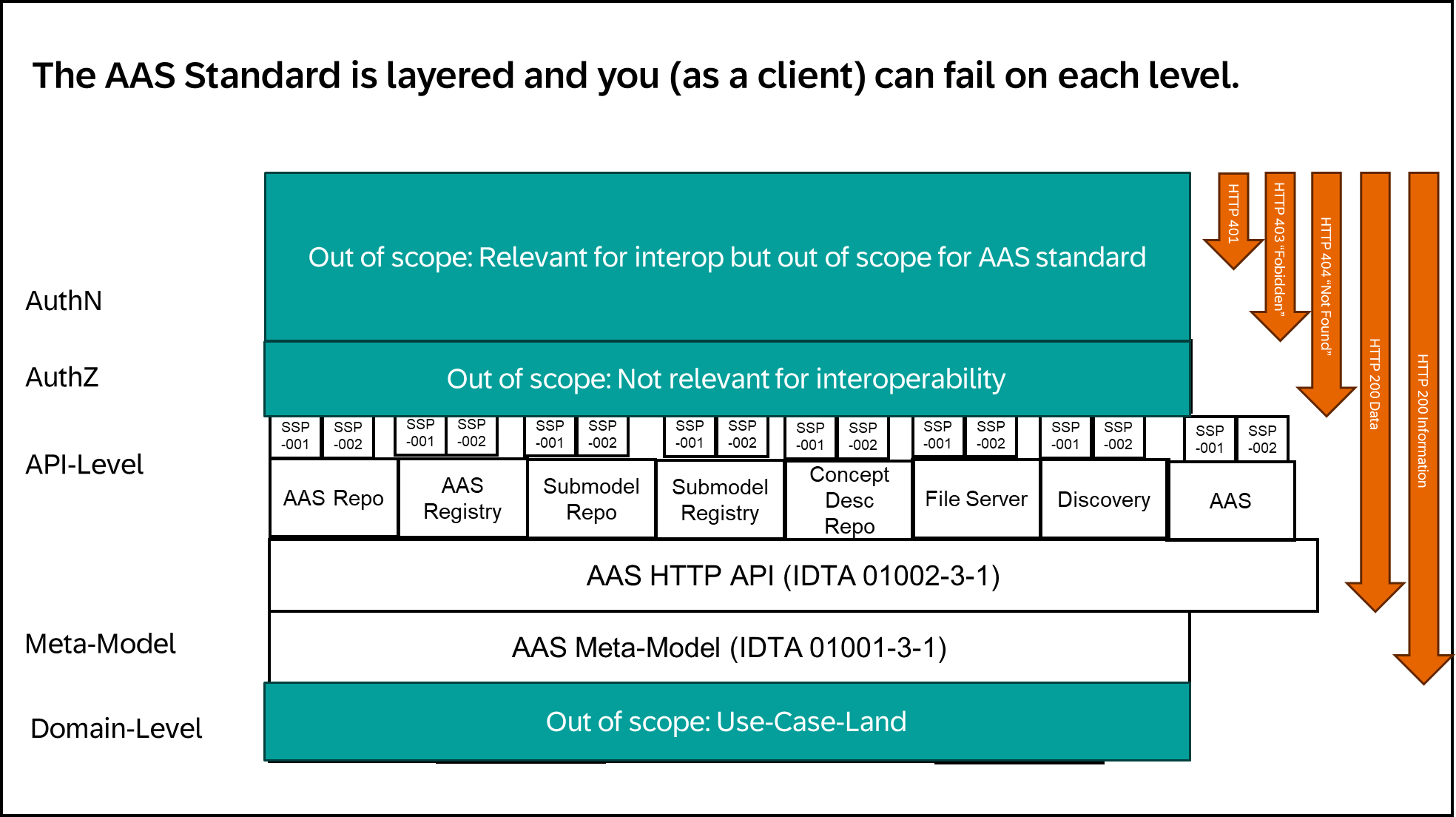
- comply with version IDTA-01002-3-0-3 for the selected interfaces and specializations defined below.
- expose their Submodels according to the HTTP binding of the
GetSubmodelinterface. - provide all
SubmodelDescriptorobjects as part of theAssetAdministrationShellDescriptorobjects via the AssetAdministratonShellRegistryServiceSpecification-SSP2. - provide
semanticIdas part of theSubmodelDescriptorobject. - provide all
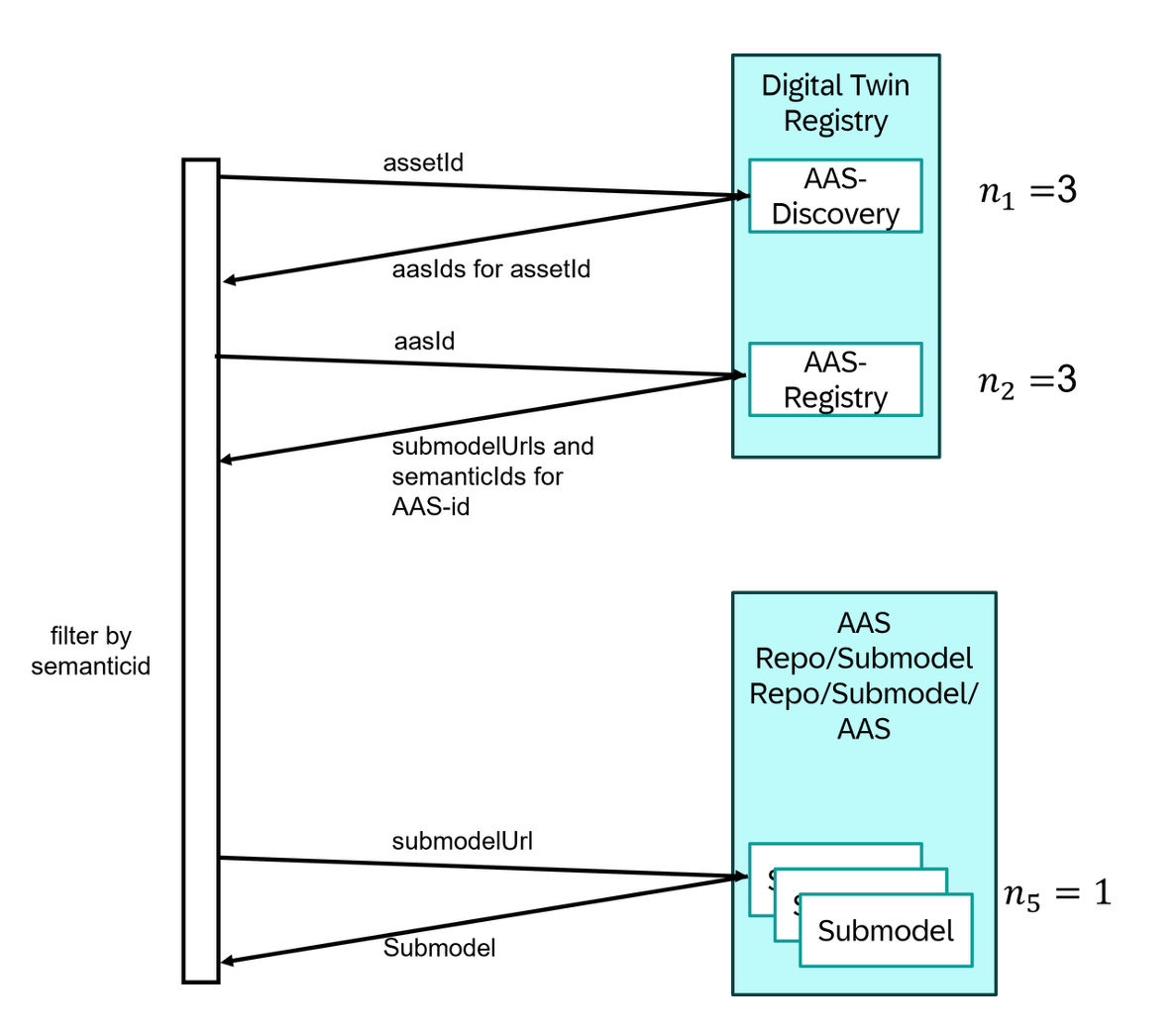
Endpointobjects as part of theSubmodelDescriptorobjects linking to an API serving theSubmodelinterface. - serve the APIs of the AssetAdministrationShellRegistryServiceSpecification-SSP2 [1] and the DiscoveryServiceSpecification-SSP1 [2] from a common URL-path.
Context
By making more optional properties in the AAS specification mandatory, the complexity can be drastically reduced.
Recurring only to the interface definition in point 1 of the solution description gives Data Providers the flexibility to use AAS Repositories, Submodel Repositories or any other service implementing the operation.
This results in reduced complexity for Data Provider and Data Consumer alike. A client that makes a certain set of different assumptions may not be compatible with Data Providers adhering to this ADR. Same holds true for clients adhering to this ADR with servers deployed in a less governed setup.
Expected business consequences
Data Providers will need to expose at least two public endpoints adhering to the mentioned API specifications. They will likely need additional internal services ensuring consistency across the Registry- and Repository interfaces. This will cause marginal integration cost.
Data Consumers will have to obtain knowledge about all Digital Twin Registry endpoints a Provider offers. What he receives is a deterministic path to the data he is attempting to discover drastically reducing the cost of discovering and fetching data.
The upcoming AAS-Spec releases in the 3.X line will be compatible to this ADR.
Scope of the ADR
This ADR does not impede on any neighboring discovery mechanisms such as ID-Link.
References
[1] AssetAdministrationShellRegistryServiceSpecification | V3.0.3_SSP-001 | Plattform_i40 | SwaggerHub
[2] DiscoveryServiceSpecification | V3.0.3_SSP-001 | Plattform_i40 | SwaggerHub